Space Launch Schedule
- 4.2
- Rating
- 100.00K
- Installs
- Free
- Price
 Analysis by App-foxy
I installed Space Launch Schedule expecting a simple way to check upcoming rocket activity, and I found an app that is most useful when several people in a household share the same curiosity. One person may follow spaceflight closely, while another only wants to know why a launch is being discussed at breakfast. This app gives both of them a focused place to look instead of relying on scattered searches, social posts, or a general news application.
It is a free events app from Kickstand Technology Inc, with a 4.2 average from around 370 ratings and more than 50 thousand installs. Those figures suggest a modest but established audience rather than a mass-market platform. I would describe it as a practical reference tool: it helps me keep an eye on launch activity around the world, but it is not trying to replace a full news service, a mission encyclopedia, or a family scheduling system.
How Space Launch Schedule fits into a shared household
The most natural use case is a shared-device moment. Imagine one person hears that a launch may happen during the evening and opens the app in the kitchen. Another family member can quickly see that the list is about space events rather than ordinary calendar appointments. A child might use it to choose a launch to watch with a parent, while an adult can use the same information to decide whether it is worth setting an alarm or planning a short viewing break.
You May Also Like

 Blood Strike: 2.5 Anniversary
Blood Strike’s Loadouts Turn Every Drop Into a Tactical Gamble
A close look at Blood Strike’s custom loadouts: how fast access to signature weapons reshapes its battle royale rhythm, rewards preparation, and narrows the gap between fights.

 Pandora - Music & Podcasts
Pandora’s Music Is Easy to Start, but Harder to Recover
Pandora’s strength is its low-effort path from a seed to a station. Its weak spot is how much confidence it asks you to place in connection, setup, and quiet recovery.

 8 Ball Pool
 Is Built on Rivalries, Rematches, and Routine
A close look at the rivalries, rematches, shared routines, and unanswered safety questions that turn a quick pool match into a persistent mobile community.

 Samsung Music
’s Quiet Strength Is Playing What You Already Own
Its reach comes less from spectacle than from dependable access to a personal library. That simplicity is both the app’s strongest retention engine and its ceiling.

 AccuWeather: Weather Radar
AccuWeather Review: A Quick, Clear Forecast for Everyday Decisions
For everyday plans, the best forecast is the one you can understand quickly. AccuWeather makes rain timing, radar, and local conditions easy to act on, with a few trade-offs.

 Hill Climb Racing
Why Hill Climb Racing Still Turns Crashes Into One More Run
A tiny car, a bumpy hill and one more upgrade: Hill Climb Racing keeps resurfacing because its simple chaos makes every near-miss feel personal.
More From Our News Desk



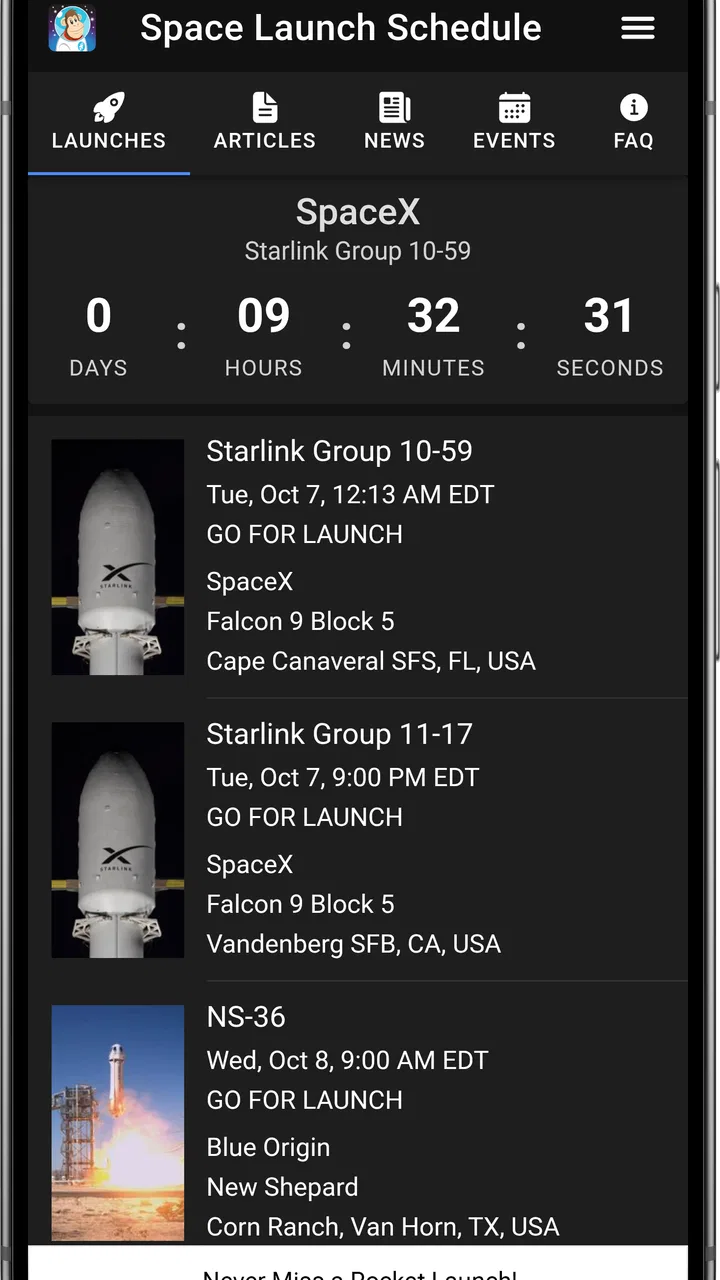
That simplicity is valuable because space launches are easy to follow casually but difficult to track consistently. Dates and times can change, different launch sites operate in different parts of the world, and a household may not want every person maintaining a separate research routine. I found the app better suited to quick shared checking than to long reading sessions. It puts the event itself at the center, which keeps the conversation focused.
There is also a useful distinction between using it together and treating it as a household organizer. I would not rely on it as the only place for family commitments, school reminders, or a detailed viewing plan. Instead, I would use it to identify an interesting launch and then discuss the practical details separately: who wants to watch, which screen to use, and whether the local time makes it realistic.
The strongest household benefit is shared awareness, not shared account management. The app can support a conversation, but it should not be mistaken for a tool that defines who may access information or coordinates responsibilities between family members.
What the first setup tells you
Space Launch Schedule runs on Android devices using at least version 6.0, so its compatibility reaches older phones and tablets as well as newer hardware. The current version is 8.2.0. In practical terms, that makes it easier to place on an older household device kept in a living room or study, provided that device meets the operating-system requirement.
I recommend setting it up on the device that people are most likely to reach when a launch comes up in conversation. A shared tablet can work well for this because several people can look at the same screen, but a personal phone is more convenient when someone wants to check while away from home. The choice is less about performance and more about access: a schedule is only useful if the right person can open it at the right moment.
One boundary is important from the beginning. A shared device does not automatically mean a shared personal space. If the phone or tablet also contains private messages, photos, or other accounts, I would avoid handing it around casually just because the launch app is open. Space Launch Schedule can be treated as a common reference point, but normal device privacy still matters.
I also would not create a family routine that depends on everyone seeing exactly the same thing at exactly the same time. A person checking from another location may be working with a different local context, and launch information can be time-sensitive. For a planned viewing, I would confirm the event again before gathering everyone. That is a sensible habit with any schedule-based space app, especially when a missed launch means the whole occasion is over.
Using the schedule to coordinate a viewing
My preferred workflow is deliberately simple. First, I scan the upcoming events and look for something that fits the household’s availability. Next, I share the event verbally or through the household’s usual messaging method. Finally, I check the timing again near the planned viewing and make sure everyone knows whether the goal is a live launch, a discussion, or simply learning about the mission.
This approach avoids a common mistake: treating an entry in a launch schedule as a guaranteed appointment. A schedule helps me plan, but it does not remove the uncertainty that surrounds real launches. Weather, technical checks, and range decisions can affect whether an event proceeds as expected. I appreciate the app more when I use it as a starting point for coordination rather than promising children or guests that a launch will definitely happen.
For a household with different time zones, the app is most useful as a shared reference before anyone makes a commitment. If one family member is traveling or living elsewhere, I would compare the displayed timing with the local clock before sending an invitation. That small extra step prevents the familiar problem of one person expecting an evening event while another receives it in the middle of the night.
A practical tip is to choose only a few events that genuinely interest the household instead of trying to follow everything. The global nature of the schedule can make the list feel busier than a local viewer needs. Selecting a small number of realistic candidates keeps the activity enjoyable and gives children a clearer sense of anticipation. It also helps adults avoid filling the family calendar with launches that are inconvenient or unlikely to be watched.
Age, trust, and conversations with children
The content rating is Everyone, which makes the app a reasonable choice for a family that wants to introduce children to launch schedules. I like that the subject naturally encourages questions about engineering, geography, timing, and exploration. A child does not need to understand every technical detail to learn how a launch site, a countdown, and an event schedule fit together.
Still, an Everyone rating should not be read as a substitute for adult judgment. Children may interpret a listed event as certain, especially if they are excited about watching it. I would explain that the schedule is a guide and that real-world events can change. That lesson is actually useful: it shows why plans sometimes move and why checking information close to the event matters.
The app also works well for age-diverse households because people can use it at different depths. A younger child may only care about when to look up at the screen, while a teenager may want to compare launch locations or understand why events happen at unusual local times. An adult can keep the conversation grounded without turning the app into a formal lesson.
Trust is more relevant here than controls. I would not hand a child a shared phone containing unrelated private material merely because the app itself is suitable for everyone. If the household uses a common tablet, that device can create a cleaner boundary between public family browsing and personal accounts. The app supports a family activity, but the device arrangement determines whether that activity is comfortable.
Where it beats ordinary alternatives
Compared with a general search engine, Space Launch Schedule is more convenient for repeated checking. A search can answer one question, but it usually requires me to remember the right wording and sort through news results, old articles, and unrelated pages. This app is more direct when my question is simply, “What launches are coming up?”
Compared with a general news app, it offers a narrower focus. News services are better when I want mission background, political context, launch outcomes, or reporting after an event. The dedicated schedule is better when I want an at-a-glance view of upcoming activity without first filtering through headlines.
Compared with a normal calendar, it is more appropriate for discovery but less appropriate for commitments. A calendar is where I would record a family viewing plan, add a reminder for a child, or coordinate a meal around an event. Space Launch Schedule is where I would look before deciding which event deserves a calendar entry. That division of labor makes sense to me and prevents the app from being judged as something it is not.
It is also different from a social feed. Social platforms can provide lively commentary and rapid updates, but they can bury the basic schedule under opinions, reposts, and unrelated material. This app provides a calmer first step. The trade-off is that a focused schedule may not give me the same depth of live discussion or immediate community reaction that a dedicated space forum can offer.
Small frictions that affect everyday use
The global scope is both the reason to install the app and the source of some friction. A worldwide schedule is exciting, but not every event will be relevant to my location or waking hours. If I am looking for a launch I can realistically watch with children after school, I still need to filter the list mentally and think about local timing.
The app’s focused design may also feel limited to users who want a complete spaceflight dashboard. Someone looking for extensive mission profiles, launch-provider background, detailed vehicle specifications, or a deep archive may prefer a specialist website or a broader space application. I would not choose this app as my only source for serious research.
Another trade-off is the difference between awareness and certainty. Seeing an event listed can motivate me to learn more, but I would avoid treating the schedule as a final guarantee. For an important group viewing, I would check again shortly beforehand and keep a backup plan, such as watching coverage later if the timing changes.
Because the app is free, it is easy to try without turning the decision into a financial commitment. That is helpful for a household that is curious but unsure whether spaceflight will become a regular interest. The more important investment is attention: if nobody checks it, it will not create a shared activity by itself.
Who should install it, and who should skip it
I would recommend Space Launch Schedule to a casual space enthusiast, a parent looking for a low-pressure science activity, or a household that enjoys making occasional plans around real-world events. It is especially suitable for someone who wants a focused schedule on an older compatible Android device rather than a large, feature-heavy information service.
I would also recommend it to a person who is tired of searching for launch dates repeatedly. The app’s value grows when it becomes a quick habit: open it, scan what is approaching, pick one realistic event, and then verify the timing before making promises. That workflow is more useful than opening it once and expecting a complete explanation of every mission.
I would skip it if my main goal were live reporting, extensive technical research, or a fully managed family calendar. A news source is better for developments around a mission, a specialist reference is better for deep background, and a calendar is better for assigning household plans. I would also skip relying on it alone if a launch is especially important to me; a second confirmation remains sensible for any time-sensitive event.
For children, I would use it with an adult nearby when the event is being turned into a learning activity. The app’s age rating makes it approachable, but the most rewarding experience comes from adding conversation: why the launch matters, where it is happening, what time it may be visible, and what the family will do if plans change.
My household verdict
After using it as a shared reference, I see Space Launch Schedule as a useful specialist app with a clear purpose. It does not try to become a private family organizer, a news newsroom, or a technical archive. Instead, it gives a household a common reason to look at the same screen and talk about an upcoming event.
Its free price and Everyone rating lower the barrier to trying it, while support for Android 6.0 keeps it practical for older shared devices. The developer, Kickstand Technology Inc, has maintained an app that has been available since Jul 29, 2015, and the current 8.2.0 release shows that it remains an active option for this narrow task.
My honest recommendation is to install it if you want a straightforward launch schedule and understand its boundaries. Use it to discover events, choose a realistic viewing opportunity, and start a conversation. Do not make it the sole authority for an important appointment, and do not confuse a public household reference with personal account sharing. Used that way, it earns a place on a family tablet or an enthusiast’s phone without demanding more from the app than it is designed to provide.
In the end, I like it because it turns a distant event into an easy shared plan. A quick check can become a question from a child, a short science discussion, or an evening spent watching something together. For me, that modest role is exactly where the app works best.
FAQs for Space Launch Schedule
01What is the primary function of the Space Launch Schedule app?
The Space Launch Schedule app is designed to provide users with detailed information on upcoming rocket launches around the world. It offers real-time updates, countdowns, and notifications, allowing space enthusiasts to stay informed about launch dates, times, and locations directly from their mobile devices.
02Does the app offer notifications for upcoming launches?
Yes, the Space Launch Schedule app provides customizable notifications to alert users of upcoming launches. You can set reminders for specific events and receive timely updates to ensure you never miss a launch. These notifications are fully adjustable to fit your preferences and schedule.
03Is the Space Launch Schedule app free to use, or does it require a subscription?
The app is free to download and use, offering basic features without any cost. However, there might be premium features available through in-app purchases or a subscription model, providing enhanced experiences such as ad-free browsing, exclusive content, or additional customization options.
04How accurate is the launch information provided in the app?
The Space Launch Schedule app sources its data from reliable space agencies and organizations, ensuring high accuracy. However, launch schedules can change due to technical issues or weather conditions. The app provides real-time updates to reflect any changes, striving to keep users as informed as possible.
05Can I watch live streams of launches through the app?
Yes, the app often includes links to live streams of launches, allowing users to watch events as they happen. These streams are usually sourced from official space agencies or broadcasters, providing high-quality viewing experiences directly within the app or via external links.
Pros
- Comprehensive launch details and updates.
- User-friendly interface with smooth navigation.
- Real-time notifications for upcoming launches.
- Customizable alerts based on user preferences.
- Detailed mission descriptions and history.
Cons
- Limited offline functionality.
- Occasional delay in live updates.
- Requires a stable internet connection.
- Ad-supported
- with in-app purchase options.
- No widget support for quick access.

Space Launch Schedule
Gallery